The Toyosu 2,400G Incident: Inside the Inertia-Defying UAP Caught Over Tokyo

The Toyosu 2,400G Incident: Inside the Inertia-Defying UAP Caught Over Tokyo



Updated: December24, 2025 | Tokyo, Japan
Hiroshi Kitajima, Space Phenomena Observatory Center (SPOC)
Supervised by Akira Kurosaki, Special Advisor to SPOC and Former Professor, The University of Tokyo
 Space Phenomena Observatory Center (SPOC) Powered by IS・INCA©
Prolouge: A 0.033-Second “Quiet Intrusion” in the Megalopolis
January 9, 2019. In the heart of Toyosu, Tokyo—a high-tech bay area buzzing with redevelopment—an automated observation system called “SID-1,” perched 130 meters above ground, captured something that defies the very foundations of human aeronautics.
It was too fast. Too alien.
While standard video cameras record 30 frames per second (fps), this object manifested for exactly one frame (0.033 seconds) before vanishing into thin air. It was a digital “scream” caught only by the electronic eye of the Space Phenomena Observation Center (SPOC). The analysis results? A slap in the face to modern physics.
Anatomy of the “Non-Human” Craft
1. A Solid Entity with a Smooth Surface
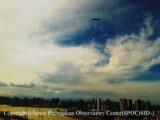
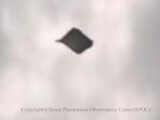
The first thing the researchers confirmed was that this was no lens flare or digital glitch. Zooming into Frame 41 reveals a “white ellipsoid” with a distinct, smooth surface.
Fig. 1: Frame 40 – Pre-appearance
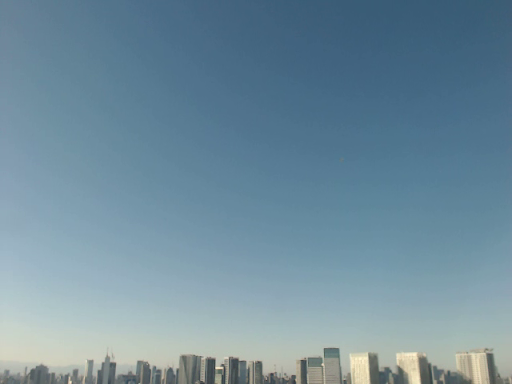
Fig. 2: Frame 41 – Appearance
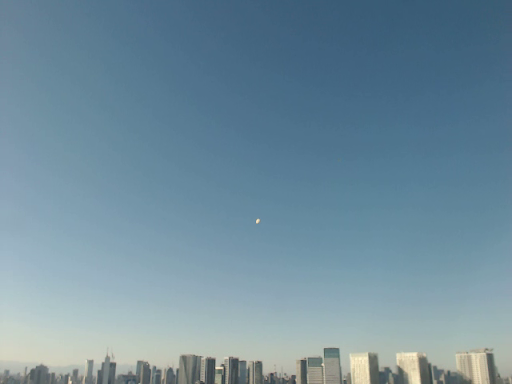
Fig. 3: Frame 41 – Appearance (Inside the white circle)
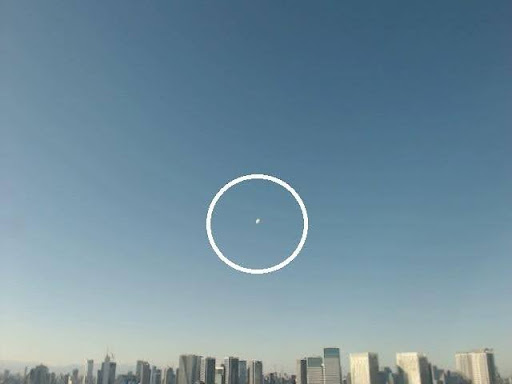
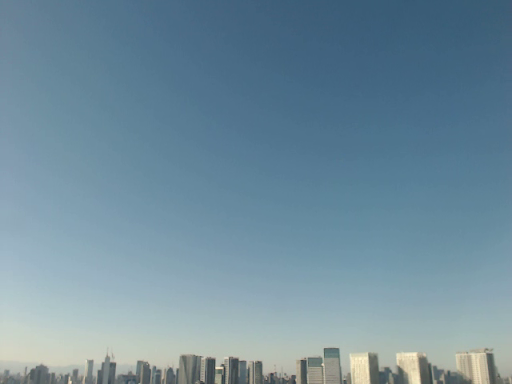
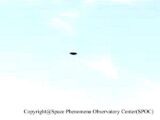
Fig. 4: Frame 42 – Disappearance
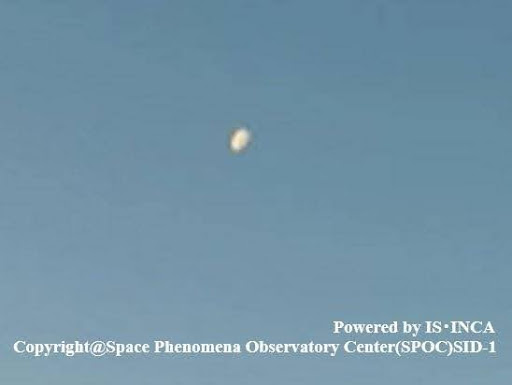
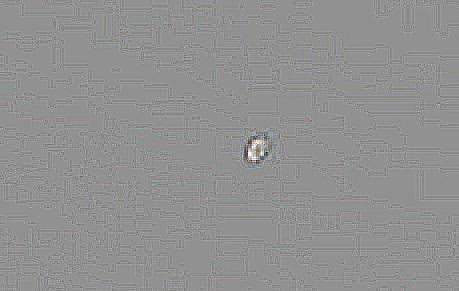
Edge-detection analysis proves the object has a clear boundary and “surface area,” distinguishing it from the blurred wings of a bird or an insect. It was a physical entity occupying space with intent.
2. The 11-Meter Giant Over Toyosu
Using trigonometry based on the SID-1’s altitude and the object’s elevation angle (approx. 10°), SPOC calculated its distance to be between 1.0 and 1.5 km. The resulting size is staggering: approximately 9 to 11 meters in length. This is not a hobbyist drone; it is a craft larger than a full-sized SUV.
The Physics-Breaker: 2,400G Acceleration
The “Toyosu UAP” earned its place in the history books due to its impossible kinematics.
1,440 km/h in a Blink
To appear in only one frame of a 30fps video means the object moved out of the field of view before the next frame could be recorded. Even using the most conservative “minimum movement” estimates, the speed reaches 960 to 1,440 km/h.
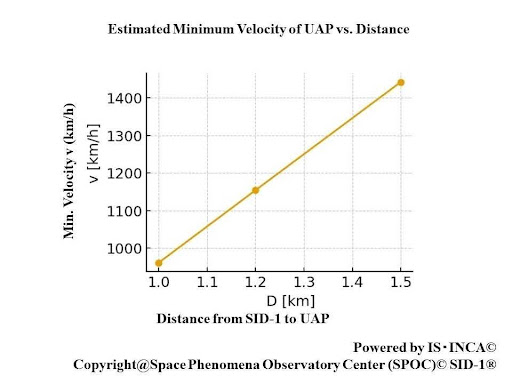
Comparison Data:
・Commercial Drone: 30–80 km/h
・Jet Airliner: 800–900 km/h
・Toyosu UAP: Up to 1,440 km/h (minimum estimate)
The Impossible 2,400G
The most terrifying metric is the acceleration. Assuming the object moved from a near-stationary state to its exit velocity within 0.033 seconds, it exerted a force of 1,600 to 2,400G.
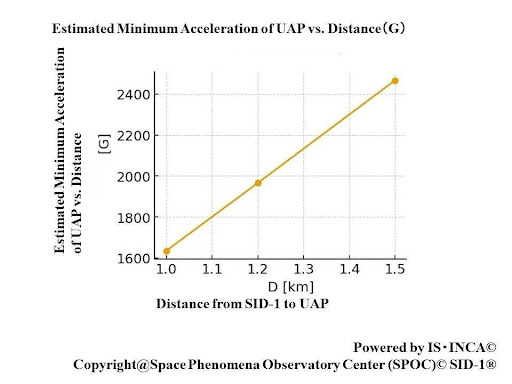
To put this into perspective:
・Human blackout limit: ~9G
・Advanced fighter jet limit: ~20G
・Toyosu UAP: 2,400G
At 2,400G, any biological occupant would be reduced to a molecular soup instantly, and any known man-made material would disintegrate. This is a “glitch” in our understanding of the physical world.
Original video see at, https://youtu.be/WUqssJ2Kkp8 (You can see with Language translation at Youtube)
Final Verdict: SPOC Level-4 Classification
SPOC has officially classified the Toyosu incident as a “Level-4: Inertia-Anomalous UAP.”
This suggests a craft that does not rely on traditional propulsion but instead controls or neutralizes inertia itself. We are looking at a technology that likely utilizes anti-gravity, electro-magnetic fluid dynamics, or perhaps the 3D projection of a 4D object slipping through the fabric of spacetime.
Space Phenomena Observatory Center(SPOC) SPOC Official UAP Classification System (DRAFT)
LEVEL 1: Light Anomaly
Cases where optical phenomena (such as lens flares, reflections, or cloud shadows) cannot be ruled out.
* Objectivity is unclear.
* Difficulty in identifying specific shapes or trajectories.
* Possibility of natural optical phenomena exists.
LEVEL 2: Physical Object
Cases where a substantial external form is confirmed, yet can be explained by known objects such as birds, balloons, or conventional aircraft.
* Maintains shape across multiple frames.
* Velocities ranging from 0 to 200 km/h.
* Within the scope of man-made objects.
LEVEL 3: High-Velocity UAP
UAPs exhibiting high-speed maneuvers that clearly exceed the velocities of natural or man-made objects.
* Velocities of 300 to over 1,000 km/h.
* Large angular displacement within 1–2 frames.
* Cannot be explained by standard aircraft or drones.
LEVEL 4: Inertia-Anomalous UAP (Inertia-Controlled Type)
UAPs exhibiting non-inertial behavior with acceleration exceeding 1,000G.
* Instantaneous acceleration, stops, or right-angle turns with zero impact/momentum.
* Appears or disappears within a single frame.
* Advanced reflection or self-luminescence.
LEVEL 5: Spacetime-Anomalous UAP
UAPs suggesting anomalies in the structure of spacetime, such as spatial warping, light-path alteration, higher-dimensional shadowing, or teleportation.
* Background distortion (suggestive of gravitational lensing).
* Loss of trajectory continuity.
* Fragmented or transparent appearance.
* Suspected 3D projection of a higher-dimensional object.
One thing is certain: on that winter day in Tokyo, we were not alone in the sky.
View all articles by Hiroshi Kitajima
※ Unauthorized reproduction, video creation, and uploading of this article's content to YouTube, blogs, or other platforms is strictly prohibited.
Related Articles

The Tokyo Monolith: Observatory Captures a Vibrating, Jet-Black UFO That Warped Spacetime
The “Black Manta” of Tokyo Bay: Robotic Observatory Captures a Bizarre, Living UFO
The Perfect Ellipse: Robotic Observatory Captures a Flawless, Two-Toned UFO Over Tokyo Bay
The “Spear-Wielding Knight”: Japanese Observatory Clocks a UFO at an Impossible 31,000 km/h

Popular Series
This is the page for The Toyosu 2,400G Incident: Inside the Inertia-Defying UAP Caught Over Tokyo. Find the latest news about SPOC, Tokyo, UFOSighting and more on TOCANA - the paranormal news media that stimulates your curiosity
UFO & UAP Latest Articles

Why Is the Universe Silent? — Is Earth Being Ignored… or Are We Being Watched?
2026.05.07 23:30 UFO & UAP
World First: UAP Captured Vanishing into Another Dimension Over Tokyo| SPOC Investigation Duo
2026.05.05 23:30 UFO & UAP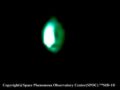
The Hex-Bolt Paradox: Engineering Why This Yokohama UAP Should Have Exploded
2026.04.26 23:30 UFO & UAP
The 4-Billion-Year-Old Artifact: Solving the Mystery of the "Cosmic Blueprint" Inside LUCA
2026.04.24 23:30 UFO & UAPCategory List
Popular Articles RankingUpdated 17:35
TOCANA - Stimulating intellectual curiosity with topics on Space, Paranormal, Religion, Art, UFOs, UMAs and more
Copyright © MICHI Inc. All Right Reserved.