UAP Science #2: Riding Waves of Spacetime

SPOC Scientific Studies on UAPs — Series I — Science-Based Speculative Studies on UAPs — PART 2/10



Space Phenomena Observatory Center (SPOC)
Representative, Hiroshi Kitajima
Special Advisor, Akira Kurosaki, Masaaki Obata
Watch the video version here:
https://youtu.be/zvIZjuxS4q4
Chapter 1 — Core Principles and Technologies
1-1. Spacetime-Distortion Propulsion
Conventional rockets and jets move forward by expelling fuel or air backward.
However, if UAP truly perform right-angle turns, sudden stops, instantaneous acceleration, and silent flight, simple reaction propulsion would be difficult to reconcile with those observations.
This leads to the idea of propulsion that distorts space itself around the craft.
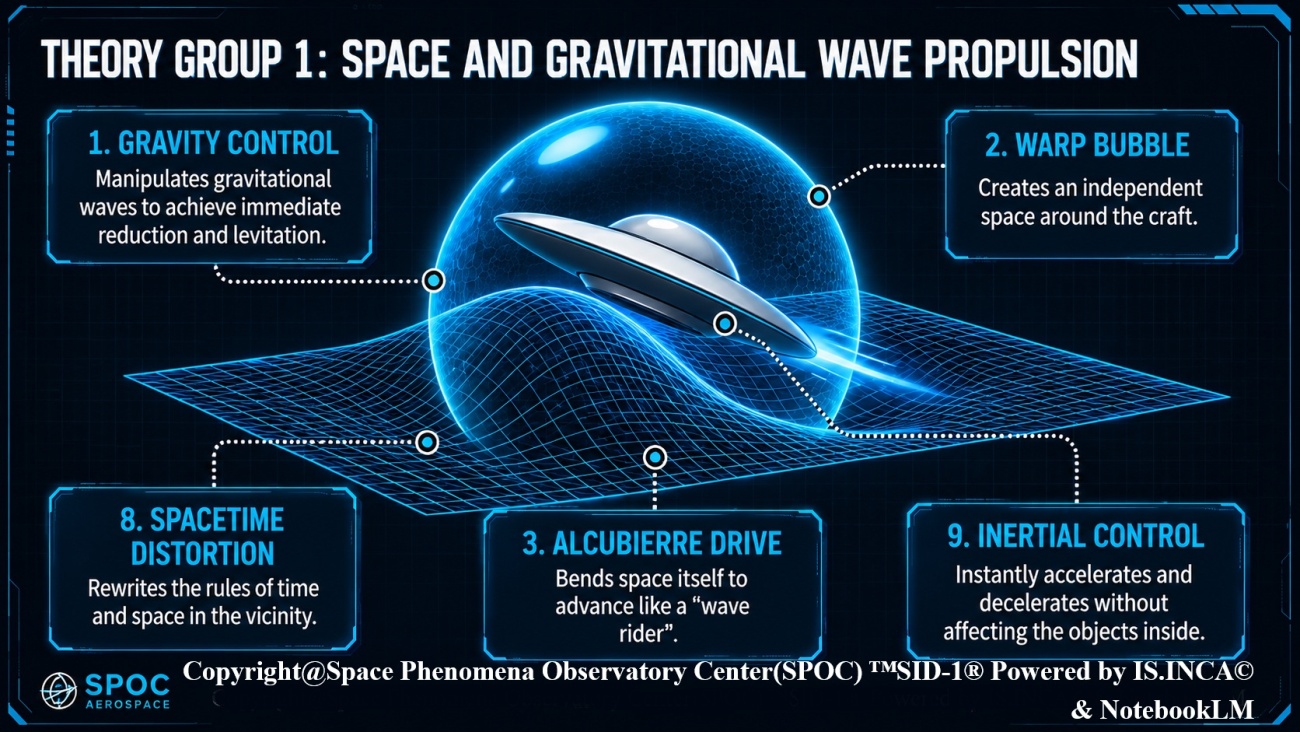
If space in front of the craft were contracted while space behind it were expanded, the craft would not need to “plow through” air or water. Instead, it could move by riding a wave of spacetime.
This idea resembles the Alcubierre drive and space-propulsion theories associated with Yoshinari Minami. From SPOC’s perspective, it could be described as “spacetime-engineering UAP propulsion.”
Yoshinari Minami is the author of Starship Theory and Space Propulsion Physics: Interstellar Flight by Field Propulsion. These works discuss space navigation for travel through the galaxy and explain space-propulsion physics for a general audience, including the concept of field propulsion.
While employed at NEC, Minami obtained a patent relating to UAP—Unidentified Anomalous Phenomena—flight characteristics viewed from the standpoint of propulsion principles, as well as flight performance derived from those principles.
UAP may be controlling the surrounding spacetime, inertia, and medium simultaneously. This is consistent with an integrated model involving:
• Spacetime Distortion
• Inertial Mass Reduction
• High-Energy Electromagnetic Fields
• Plasma Envelopes
• Higher-Dimensional Navigation
Under such a model, a UAP might be less directly affected by aerodynamic drag, water resistance, shock waves, and frictional heating.
This could therefore provide a theoretical framework for transmedium travel—continuous movement through the atmosphere, underwater, and in space.
1-2. Yoshinari Minami’s Field Propulsion Theory
Several theories have been proposed as possible core technologies.
Yoshinari Minami has discussed the performance limitations of present-day rocket propulsion and introduced field propulsion as a new conceptual approach intended to go beyond them.
One representative example of field propulsion is space-drive propulsion based on pressure thrust arising from the mechanical structure of space.
In this concept, spacecraft propulsion makes use of a local field interaction produced through the relationship between the spacecraft and the surrounding spacetime.
In other words, the spacecraft would propel itself relative to the structure of spacetime.
From a cosmological perspective, Minami has also introduced propulsion concepts based on local expansion of space and field-theoretical propulsion principles, including the possibility of propulsion associated with superstring theory as a form of quantum propulsion.
He has also discussed promising propulsion concepts based on the astrophysics of accretion disks around black holes.
Finally, his work addresses navigation theory for intergalactic or interstellar travel using field propulsion, including a hyperspace-navigation concept intended to bypass the light-speed barrier—in other words, to “jump” the light barrier.
1-3. Elizondo’s “Spacetime Bubble”
Elizondo has presented the idea of forming a localized “spacetime bubble” around a craft.
This is not simply a matter of moving forward with propellant.
• Contract space in front of the craft
• Expand space behind the craft
The idea is to move the “space” around the craft rather than propelling the craft itself through the medium.
Theoretically, this concept is related to:
• The Alcubierre drive
• General relativity
• Vacuum-energy theory
• Yoshinari Minami’s theories
Inside such a “bubble,” the effects of the following might be greatly reduced:
• Inertia
• Gravity
• Aerodynamic drag
• Fluid resistance
This could provide a theoretical explanation for why a UAP might undergo:
• Rapid acceleration
• Right-angle turns
• Silent flight
• Instantaneous stops
• High-speed underwater travel
without being destroyed in the manner expected for a conventional aircraft.
In other words, the image is that a UAP is not so much “flying” as it is “moving by riding a wave of spacetime.”
Original video:
https://youtu.be/rYiSPnRjrJw
Chapter 2 — Inertial Mass Reduction
An important development in current UAP hypotheses is the shift from the idea of “canceling gravity” toward the idea of controlling inertia itself.
A group of patents associated with U.S. Navy aerospace engineer Salvatore Pais, which attracted considerable attention, centers on several concepts.
Pais is known for patents involving an inertial mass reduction device and a high-energy electromagnetic field generator—technologies that have sometimes been discussed in connection with UAP.
The central concepts include:
• High-frequency electromagnetic fields
• Vacuum polarization
• Inertial mass reduction
A high-frequency electromagnetic field is a powerful electromagnetic field oscillating at extremely high frequency. Research has explored whether such fields might produce unusual effects on matter or the surrounding physical environment.
Vacuum polarization is a quantum phenomenon in which a strong electromagnetic field alters the quantum state of the vacuum and changes the distribution of virtual particles.
Put more simply, it is a phenomenon in which a strong electromagnetic field changes the energy state of apparently empty space.
Inertial mass reduction is the hypothesis that the inertia of an object could be artificially reduced, potentially enabling rapid acceleration and extreme maneuverability.
If the inertial mass of an object could be drastically reduced, the following might theoretically become possible:
• Rapid acceleration
• Extremely high-speed turns
• Avoidance or reduction of G-loads
Although this idea can be viewed as an extension of 1950s concepts such as the Dean Drive and antigravity research, it is now being reinterpreted in relation to:
• The quantum vacuum
• High-energy fields
• Spacetime geometry
NEXT — PART 3/10
If inertia itself could be controlled, another fundamental question emerges:
Where would the enormous energy required for such a system come from?
In PART 3, we examine Vacuum Energy and Quantum Fields—including zero-point energy, virtual particles, vacuum fluctuations, the Casimir effect, dark energy, and dark matter—and consider whether the apparently “empty” vacuum could hold clues to an entirely different form of propulsion.
— End of PART 2 —
Continued in PART 3 →
View all articles by Hiroshi Kitajima
※ Unauthorized reproduction, video creation, and uploading of this article's content to YouTube, blogs, or other platforms is strictly prohibited.
Related Articles

Why Is the Universe Silent? — Is Earth Being Ignored… or Are We Being Watched?
World First: UAP Captured Vanishing into Another Dimension Over Tokyo| SPOC Investigation Duo
The Toyosu 2,400G Incident: Inside the Inertia-Defying UAP Caught Over Tokyo
The Hex-Bolt Paradox: Engineering Why This Yokohama UAP Should Have Exploded



Popular Series
This is the page for SPOC Scientific Studies on UAPs — Series I — Science-Based Speculative Studies on UAPs — PART 2/10. Find the latest news about SPOC, UAP, uap-science-series and more on TOCANA - the paranormal news media that stimulates your curiosity
UFO & UAP Latest Articles

Why Is the Universe Silent? — Is Earth Being Ignored… or Are We Being Watched?
2026.05.07 23:30 UFO & UAP
World First: UAP Captured Vanishing into Another Dimension Over Tokyo| SPOC Investigation Duo
2026.05.05 23:30 UFO & UAP
The Toyosu 2,400G Incident: Inside the Inertia-Defying UAP Caught Over Tokyo
2026.05.03 23:30 UFO & UAPCategory List
Popular Articles RankingUpdated 05:35
TOCANA - Stimulating intellectual curiosity with topics on Space, Paranormal, Religion, Art, UFOs, UMAs and more
Copyright © MICHI Inc. All Right Reserved.