UAP Science #3: Is the Vacuum Really Empty?

SPOC Scientific Studies on UAPs — Series I — Science-Based Speculative Studies on UAPs — PART 3/10



Space Phenomena Observatory Center (SPOC)
Representative, Hiroshi Kitajima
Special Advisor, Akira Kurosaki, Masaaki Obata
Watch the video version here:
https://youtu.be/zvIZjuxS4q4
Chapter 3 — Vacuum Energy and Quantum Fields
A concept that appears frequently in recent UAP theories is the quantum-mechanical idea that:
“The vacuum is not truly empty.”
In quantum field theory, even a vacuum is understood to involve:
• Zero-point energy
• Virtual particles
• Vacuum fluctuations
Zero-Point Energy
Zero-point energy is the minimum residual energy that remains even in a system at its lowest possible energy state.
In other words, even when a physical system is reduced to its lowest-energy state, its energy does not necessarily become completely zero.
This is one reason why the quantum-mechanical concept of the vacuum differs significantly from the everyday idea of completely “empty space.”
Virtual Particles
Virtual particles are quantum-level excitations that are often described as appearing and disappearing transiently in the vacuum.
They are associated with quantum-field descriptions of what occurs even in apparently empty space.
Vacuum Fluctuations
Vacuum fluctuations are minute quantum variations that occur even in what appears to be empty space.
Some researchers speculate that UAP might somehow make use of minute forms of energy associated with the vacuum.
This has not been demonstrated.
However, the subject is related to frontier areas of modern physics such as:
• The Casimir effect
• Vacuum polarization
• Quantum gravity
The Casimir Effect
The Casimir effect is a measurable quantum phenomenon in which closely spaced conducting plates experience a force associated with quantum fields.
This is important because it demonstrates that effects associated with quantum fields in the vacuum are not merely philosophical concepts.
However, the existence of the Casimir effect does not demonstrate that usable propulsion energy can be extracted from the vacuum.
That distinction is essential when considering possible UAP propulsion systems.
Vacuum Polarization
Vacuum polarization is a quantum phenomenon in which strong electromagnetic fields alter the effective state of the vacuum.
This concept is particularly interesting in relation to hypothetical UAP technologies involving extremely powerful electromagnetic fields.
If an advanced technological system were capable of manipulating matter, electromagnetic fields, and the quantum vacuum in ways far beyond present human engineering, vacuum polarization might become relevant to theoretical propulsion concepts.
At present, however, such an application has not been scientifically demonstrated.
Quantum Gravity
Quantum gravity refers to theoretical efforts to describe gravity within a quantum framework and ultimately reconcile gravity with the other fundamental laws of physics.
Gravity is described extraordinarily well on large scales by general relativity.
Quantum mechanics, meanwhile, provides the fundamental framework for understanding matter and interactions at extremely small scales.
A complete theory that successfully unifies these domains remains one of the major unresolved challenges of modern physics.
For this reason, discussions of advanced propulsion involving both spacetime and quantum phenomena naturally lead to questions concerning quantum gravity.
Could Vacuum Energy Power a UAP?
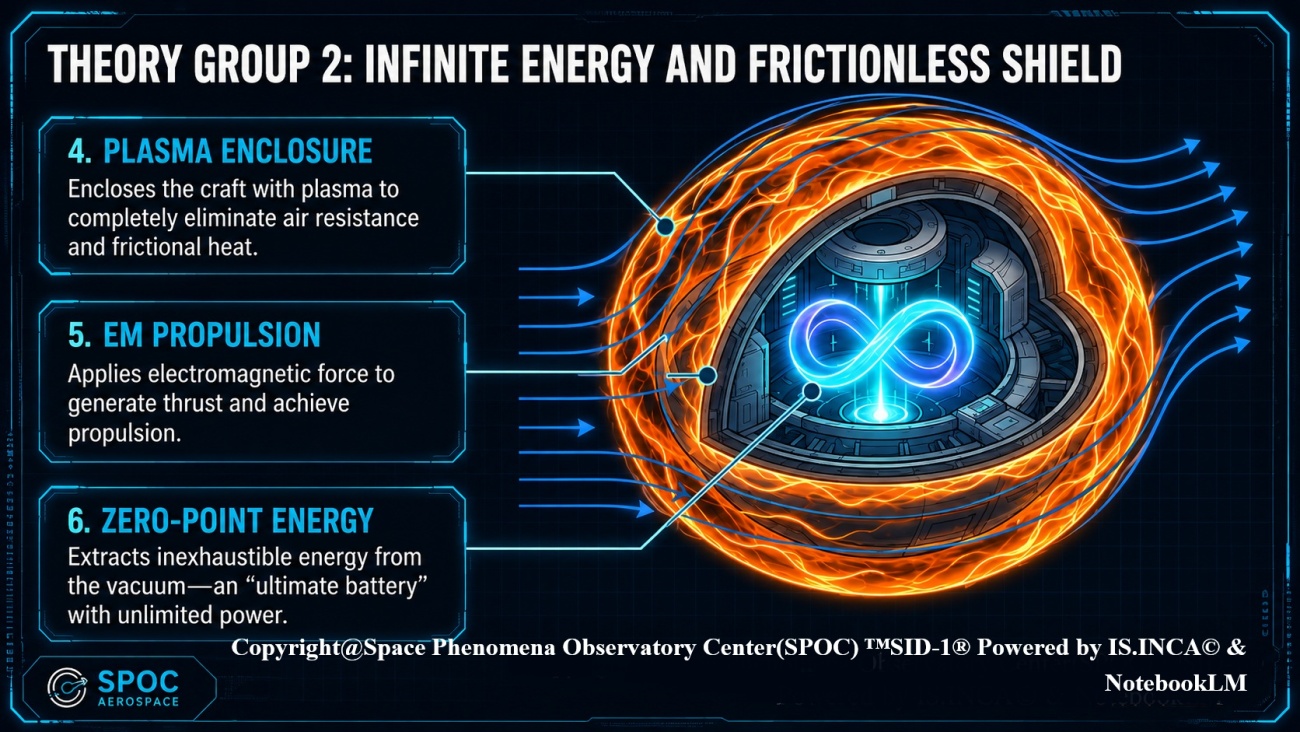
In recent years, some researchers have discussed the possibility that vacuum energy or zero-point energy could serve as an energy source for UAP.
Others have also drawn attention to dark matter and dark energy, which are believed to constitute major components of the universe.
However, these three concepts should not be confused.
They represent fundamentally different ideas in modern physics and cosmology.
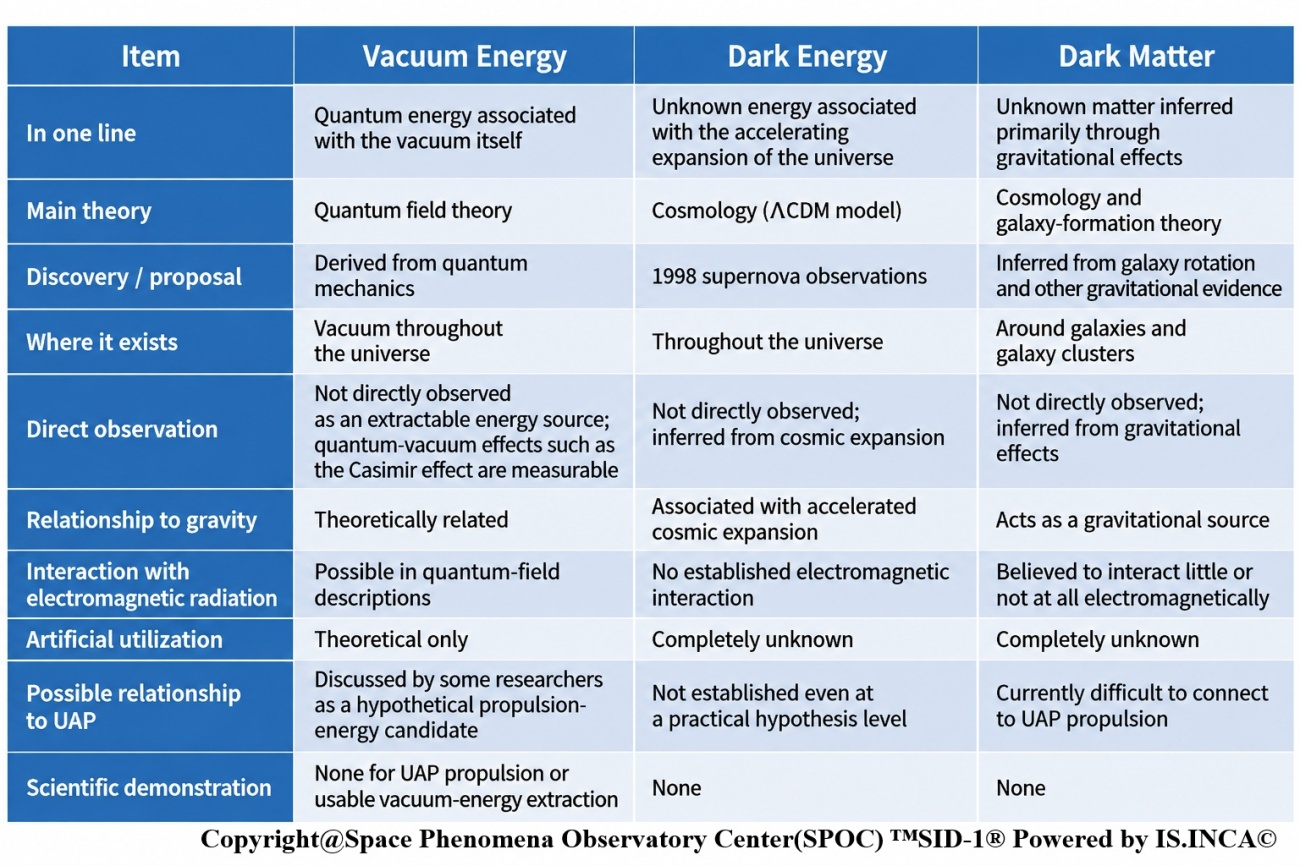
Vacuum Energy
In one line:
Quantum energy associated with the vacuum itself.
Its principal theoretical foundation is quantum field theory.
The concept arises from quantum mechanics and quantum-field descriptions of the vacuum.
Vacuum-related phenomena occur throughout space.
Vacuum energy itself has not been directly observed as an extractable energy source, although quantum-vacuum effects such as the Casimir effect are measurable.
Its relationship to gravity is theoretically important, and interactions involving electromagnetic fields can arise in quantum-field descriptions.
Artificial utilization remains theoretical only.
Some researchers have discussed vacuum energy as a hypothetical candidate for advanced propulsion or energy systems.
But there is currently:
No scientific demonstration of usable vacuum-energy extraction for UAP propulsion.
Dark Energy
In one line:
Unknown energy associated with the accelerating expansion of the universe.
Dark energy is primarily considered within modern cosmology, particularly the ΛCDM model.
Its existence is inferred from observations of the accelerating expansion of the universe, including the landmark supernova observations reported in 1998.
Dark energy is thought to exist throughout the universe.
It has not been directly observed as a usable form of energy.
There is no established electromagnetic interaction that would allow it to be manipulated using present-day technology.
Artificial utilization is completely unknown.
Therefore, its possible relationship to UAP propulsion has not been established even at a practical hypothesis level.
Dark Matter
In one line:
Unknown matter inferred primarily through gravitational effects.
Dark matter plays an important role in cosmology and theories of galaxy formation.
Its existence is inferred from phenomena such as galaxy rotation and other gravitational evidence.
Dark matter is believed to be distributed around galaxies and galaxy clusters.
It has not been directly observed in the sense of identifying its fundamental particle nature, but its presence is inferred through gravitational effects.
Unlike ordinary matter, it is generally believed to interact very weakly—or perhaps not at all—through electromagnetic radiation.
Its artificial utilization is completely unknown.
At present, it is therefore difficult to connect dark matter directly with a practical UAP propulsion mechanism.
Three Very Different Concepts
To summarize:
Vacuum Energy
Associated with quantum fields and the vacuum itself.
Dark Energy
Associated with the accelerating expansion of the universe.
Dark Matter
Unknown matter inferred mainly through its gravitational effects.
Although all three involve major unanswered questions in physics, they should not be treated as interchangeable energy sources.
In particular, there is currently no scientific demonstration that any of these can serve as a practical energy source for UAP propulsion.
Vacuum energy, vacuum fluctuations, and vacuum polarization are concepts grounded in quantum field theory.
Their possible relationship to UAP propulsion has been discussed by some researchers, but no such propulsion application has been demonstrated.
What Would We Expect to Observe?
If a hypothetical UAP could manipulate spacetime, inertia, electromagnetic fields, or the quantum vacuum, then such technology might produce flight characteristics radically different from those of conventional aircraft.
The next question therefore becomes:
Do actual UAP observations show characteristics that could be consistent with such a model?
This brings us from theoretical physics to observation.
In the next part, we examine reported UAP characteristics identified through observations by the U.S. Department of Defense and by SPOC’s SID-1 automated observation system.
These include phenomena such as:
• Antigravity-like lift
• Instantaneous acceleration
• Hypersonic flight
• Low observability
• Transmedium travel
• Sudden appearance and disappearance
The critical question is no longer simply:
“What might power a UAP?”
It becomes:
“What does a UAP actually appear to do when it is observed?”
NEXT — PART 4/10
Chapter 4 — Observed Characteristics
In PART 4, we move from theoretical propulsion and energy concepts to actual reported observations.
What characteristics have been recorded?
Can UAP really accelerate without visible propulsion?
Why are sonic booms sometimes apparently absent?
How could an object move between the atmosphere, space, and underwater environments?
And what can observations made by the U.S. Department of Defense and SPOC’s SID-1 system tell us?
— End of PART 3 —
Continued in PART 4 →
View all articles by Hiroshi Kitajima
※ Unauthorized reproduction, video creation, and uploading of this article's content to YouTube, blogs, or other platforms is strictly prohibited.
Related Articles

SPOC Scientific Studies on UAPs — Series I — Science-Based Speculative Studies on UAPs — PART 2/10
SPOC Scientific Studies on UAPs — Series I — Science-Based Speculative Studies on UAPs — PART 1/10
Why Is the Universe Silent? — Is Earth Being Ignored… or Are We Being Watched?
World First: UAP Captured Vanishing into Another Dimension Over Tokyo| SPOC Investigation Duo


Popular Series
This is the page for SPOC Scientific Studies on UAPs — Series I — Science-Based Speculative Studies on UAPs — PART 3/10. Find the latest news about SPOC, UAP, uap-science-series, Vacuum-Energy, Quantum-Physics and more on TOCANA - the paranormal news media that stimulates your curiosity
UFO & UAP Latest Articles

Why Is the Universe Silent? — Is Earth Being Ignored… or Are We Being Watched?
2026.05.07 23:30 UFO & UAP
World First: UAP Captured Vanishing into Another Dimension Over Tokyo| SPOC Investigation Duo
2026.05.05 23:30 UFO & UAPCategory List
Popular Articles RankingUpdated
TOCANA - Stimulating intellectual curiosity with topics on Space, Paranormal, Religion, Art, UFOs, UMAs and more
Copyright © MICHI Inc. All Right Reserved.